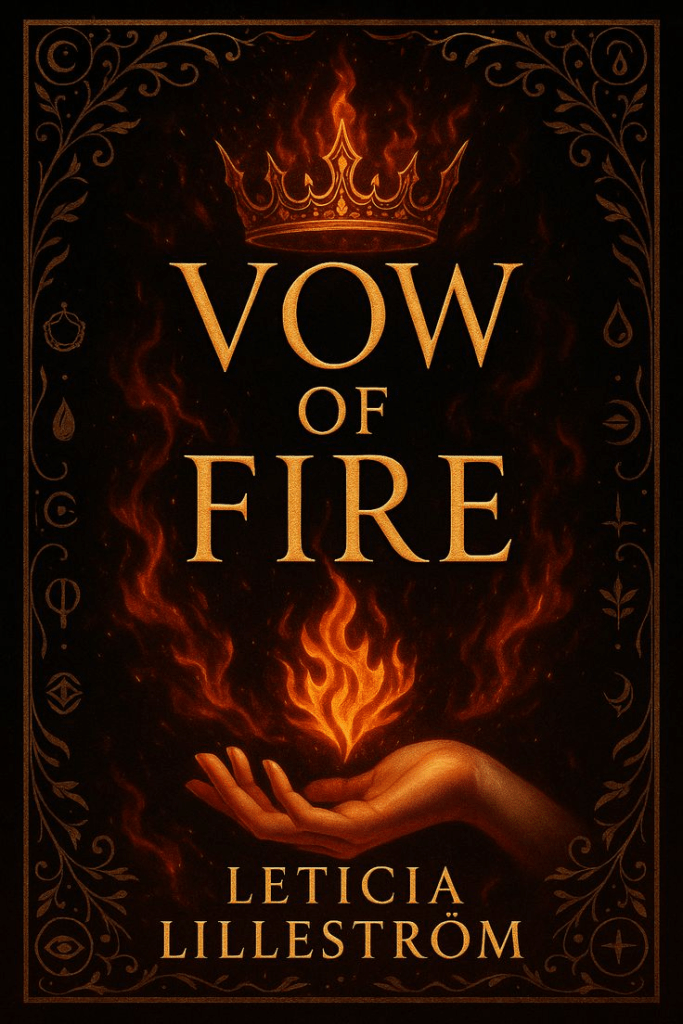
There is a kind of fire that performs.
It dazzles.
It announces.
It turns pain into spectacle and calls it power.
And then there is the other kind.
The kind that does not entertain.
The kind that does not ask to be understood.
The kind that arrives quietly — and begins to remove what is false.
Vow of Fire was written from that second place.
Not as a lesson.
Not as a manifesto.
Not as a promise of becoming “better.”
But as a record of what happens when heat touches a life that has been trained to be manageable.
Because fire, at its most honest, does not improve you.
It reveals you.
It burns through the soft compromises.
It exposes the agreements you never remember signing.
It lights up the precise moment you learned to swallow your own no.
And it asks nothing except this:
Will you keep living as if your silence is virtue?
Fire as a Vow, Not a Mood
In this world, a vow is not an intention.
It is not an aesthetic.
It is not a chapter title.
A vow is a binding.
It changes the shape of what you can tolerate.
It alters the cost of pretending.
It makes certain lives impossible to continue.
Fire is often romanticised as freedom — but in Vow of Fire, it is something sharper:
A demand for congruence.
Not loudness.
Not chaos.
Not destruction for its own sake.
Just the end of a long, polished performance called being fine.
The Empire That Trains You to Be Safe
Some systems do not need to cage you.
They only need you to become “reasonable.”
Reasonable in your grief.
Reasonable in your anger.
Reasonable in what you ask for.
Reasonable in what you settle for.
Reasonable in how you disappear.
And you can live like that for years — praised for it, even.
Until one day the heat rises.
Not because you chose it.
Because something in you refuses to be organised any longer.
Fire does not arrive to make you a villain.
It arrives to make you unalignable with the thing that was slowly killing you.
What Fire Protects
This is the secret that doesn’t get quoted enough:
Fire is not only ruin.
Fire is protection.
It guards what is sacred by making the profane uncomfortable.
It forces clarity where charm once worked.
It ends negotiations you didn’t realise you were having with your own dignity.
Fire says:
You do not get to touch me and call it love.
You do not get to take from me and call it loyalty.
You do not get to demand my obedience and call it belonging.
And if that sounds extreme, it is only because you’ve been trained to think self-abandonment is normal.
Why This Story Lives Here
Lirael is not a place for instruction.
So this is not a “what you should learn from the book” post.
This is simply the atmosphere Vow of Fire carries:
A slow ignition.
A private uprising.
A refusal that becomes holy because it finally becomes yours.
Some readers will meet it as fantasy.
Others will recognise it as something older:
the inner moment when you stop negotiating with what you know.
When you stop calling the burn “overreaction.”
When you stop calling your hunger “neediness.”
When you stop calling your boundaries “drama.”
When you stop translating your truth into something that makes other people comfortable.
If You Feel the Heat
You are not required to act.
You are not asked to change your life overnight.
You are not being recruited into transformation.
But if something in you becomes quiet while reading this —
if a part of you recognises the tone —
then you already understand what Vow of Fire is.
Not a book about fire.
A book about the moment you realise:
your life cannot be built on self-betrayal and still call itself yours.
This piece echoes themes explored more fully in Vow of Fire (Book One of The Seven Vows). The book is not required reading — it is simply where this atmosphere was given a longer form.
 Lirael
Leave a comment